We are living in an age of profound disconnection—not just from one another, but from the feminine principle within ourselves. As society glorifies productivity, power, status and endless consumption, the heart is slowly forgotten. This article explores how our separation from the feminine is shaping modern relationships, mental health and collective consciousness, and why integrating …

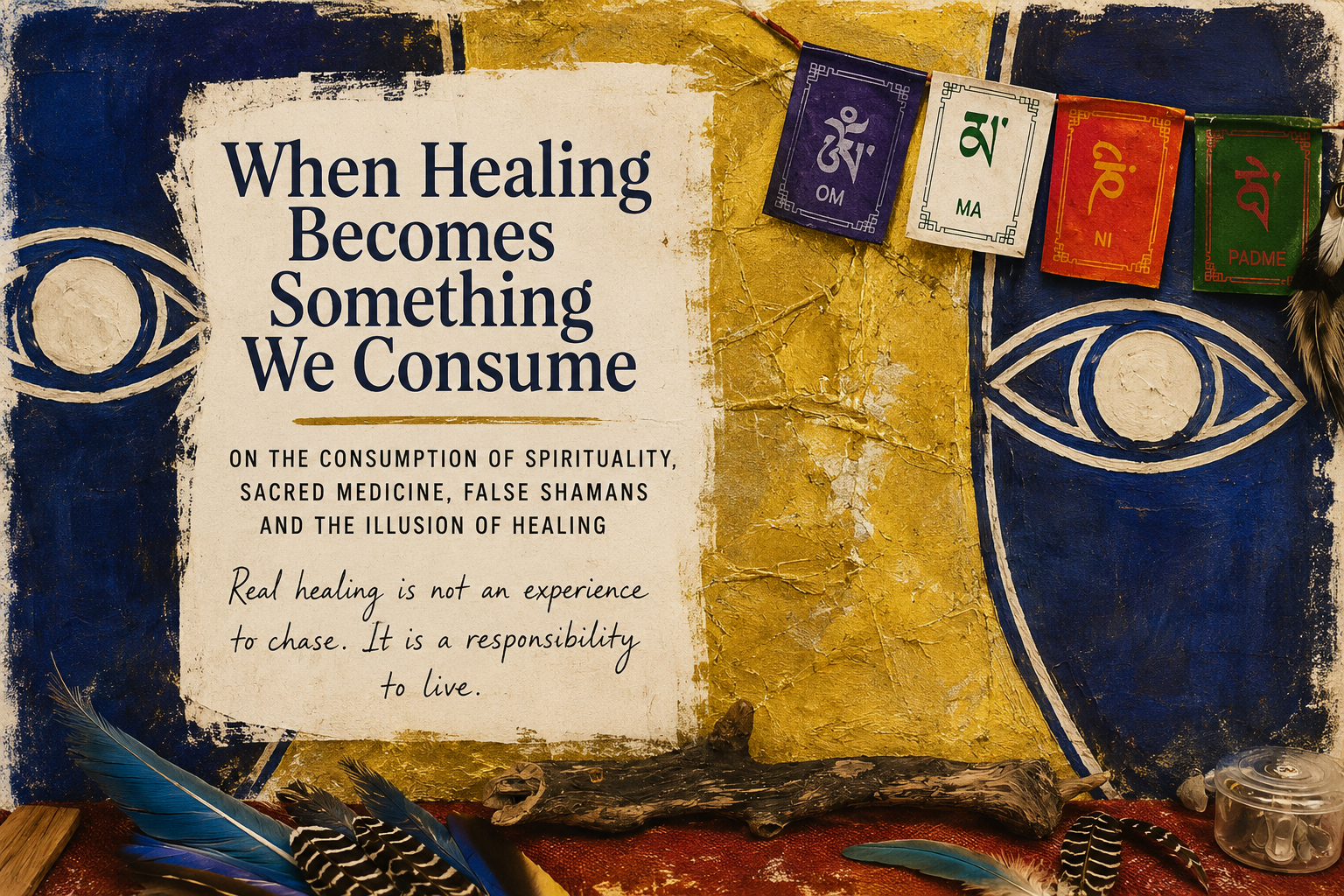
When Spirituality Becomes Another Form of Consumerism
We are living in a strange age of spirituality. Never before have so many people had access to meditation, yoga, breathwork, plant medicines, retreats, ceremonies, online courses, healers and spiritual teachers. And yet, with all this access, I often wonder whether we are becoming more connected to ourselves — or simply becoming better consumers of spirituality.
Another retreat. Another ceremony. Another plant medicine journey. Another course promising transformation. Another facilitator telling us that we are about to awaken, ascend or finally heal.
The danger is not spirituality itself. The danger is when spirituality becomes another product to consume, another identity to wear, or another experience to chase.
The Sacred Becoming a Product
Across the world, traditional healing practices are increasingly being removed from the cultures, communities and relationships from which they emerged. Sacred medicines that have existed within particular cosmologies and traditions are now being packaged into weekend experiences, luxury retreats and Instagram content.
This does not mean that ancient traditions should be frozen in time or inaccessible to outsiders. Nor does it mean that every non-Indigenous facilitator is automatically fraudulent. The question is more uncomfortable than that:
What happens when we take a practice out of its cultural, ethical and relational context and turn it into a commodity?
Who carries the knowledge? Who benefits financially? Who is accountable when someone is harmed? What happens to the elders, communities and lineages from which the practice originated?
There is no single definition of a “shaman,” and different Indigenous cultures have their own names, roles and traditions. But that is precisely why we should be careful about the modern tendency to use shaman as a marketing title that anyone can simply adopt after attending a few ceremonies.
The Rise of the Spiritual Consumer
It is incredibly easy to consume spirituality. You can fly to a retreat, drink a sacred medicine, have an extraordinary experience, cry for eight hours, see visions, feel connected to the universe and return home believing that something fundamental has changed.
And perhaps something has opened. But an opening is not the same as integration.
Taking a medicine does not automatically rewire years of conditioning. One ceremony does not dissolve attachment wounds. Seeing a vision does not mean you have learned how to communicate differently with your partner. Feeling love for the universe does not automatically mean you know how to sit with your anger, grief, jealousy or shame.
This is where the idea of spiritual bypassing becomes important: using spiritual beliefs or experiences to avoid unresolved psychological pain rather than actually meeting it. Recent psychological research continues to distinguish between spirituality that supports emotional engagement and an avoidant form of spirituality that can become a defence against difficult inner work.
Sometimes spirituality becomes a beautiful escape from the very life we are supposed to be learning how to live.
Healing Is Not Always Beautiful
Real healing can be deeply painful. It can mean grieving the childhood you never had. Looking at the ways you manipulate others. Recognising that you have repeated the same relationship pattern for twenty years. Taking responsibility for the pain you have caused. Sitting with rejection instead of immediately trying to transcend it.
It means shedding identities that once kept you safe.
And that is not something that can necessarily be achieved through the mere consumption of another sacred medicine.
These medicines may have profound potential. There is growing scientific interest in psychedelic-assisted approaches and traditional medicines, and many people report meaningful psychological and spiritual experiences. But no medicine can do the ongoing work of living differently on your behalf.
You still have to return home.
You still have to have the difficult conversation.
You still have to notice your patterns.
You still have to take responsibility for your behaviour.
You still have to learn how to regulate yourself when life does not feel magical.
Integration Is Where the Work Begins
The ceremony is not necessarily the end of the healing journey. Sometimes it is the beginning. Integration means asking: What do I do with what I have experienced?
How does that insight change the way I love? Work? Relate? Parent? Make decisions? Respond to conflict?
Without integration, we can become collectors of profound experiences while remaining fundamentally unchanged.
We can speak beautifully about consciousness while being unable to take accountability. We can talk about unconditional love while repeatedly abandoning ourselves.
We can call ourselves awakened while treating other people badly.
We can chase ascension while remaining disconnected from our own bodies, relationships and unresolved wounds.
That is the paradox of false spirituality: it can create the feeling of transformation without demanding the responsibility that transformation requires.
Spirituality Is Not Another Thing to Buy
In a world where spirituality is increasingly sold through retreats, certifications, webinars, online courses and carefully curated social media identities, discernment matters.
Ask questions.
Who taught this person?
What is their relationship with the tradition they are representing?
Are they transparent about their training and limitations?
Do they encourage dependency, or your own agency?
Do they speak only about bliss and transformation, or also about risk, preparation, accountability and integration?
Are you seeking a genuine encounter with yourself — or simply looking for another experience to consume?
There is nothing wrong with attending a retreat, taking a course or seeking guidance. I am not arguing for a rejection of spiritual practice. I am questioning the idea that more spiritual experiences automatically mean more consciousness.
Perhaps healing is not about constantly searching for the next ceremony.
Perhaps it is about learning how to stay.
To stay with ourselves when the ceremony is over.
To stay with the grief we wanted to transcend.
To stay with the wound instead of covering it with another spiritual identity.
To take ownership of our lives.
Because spirituality without embodiment can become fantasy. Healing without accountability can become performance. And sacred medicine without context, responsibility and integration can become just another product in the marketplace of human longing.
The easiest thing in the world is to become a consumer.
Even a spiritual consumer.
The harder thing is to stop searching outside yourself long enough to ask:
What am I actually avoiding?
And perhaps that is where the real journey begins
Book a Consultation
It’s easy and free!